Netflix–Warner Bros. Megamerger Triggers Global Shockwaves as Regulators Prepare for a Landmark Fight
A Transformative Bet in a Slowing Streaming Economy
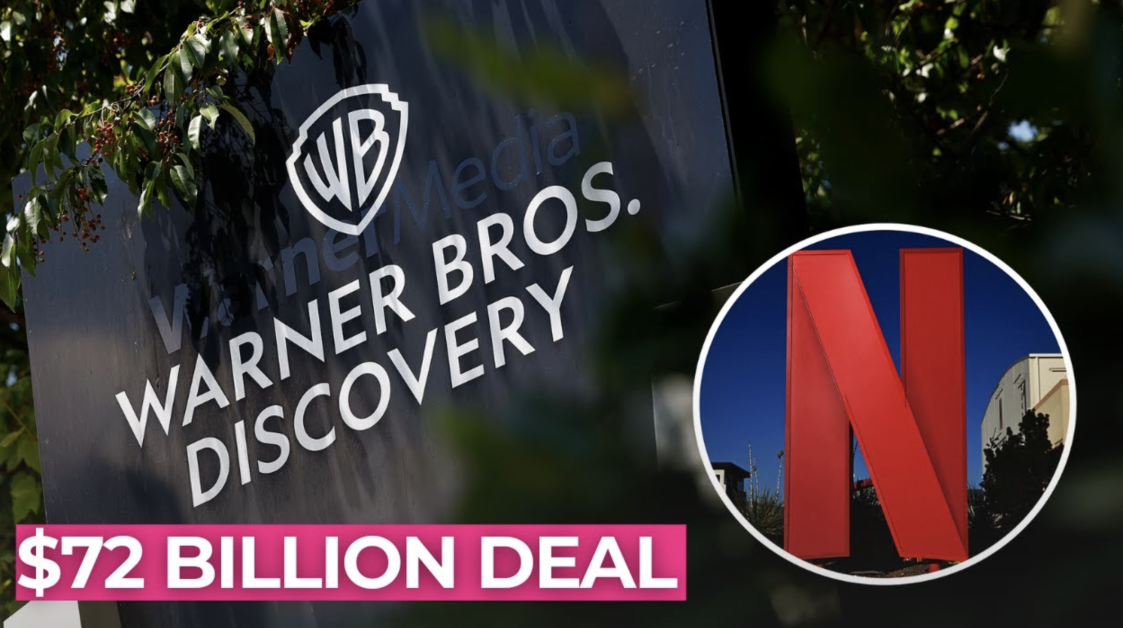
Netflix’s $72 billion agreement to acquire Warner Bros Discovery’s studios and streaming business has rapidly become the defining media story of the year—hailed by some as a bold strategic realignment, and criticized by others as another step toward an over-consolidated entertainment landscape.
For Netflix, the world’s largest streaming platform, the deal represents a high-stakes play to fuse its massive global distribution engine with Warner’s deep production muscle and prized intellectual property. The combination could create one of the most formidable content ecosystems ever built, uniting audience reach with franchises that shaped modern storytelling—Harry Potter, Game of Thrones, DC Comics, HBO’s award-winning slate, and a century-old production library.

Image: David Zaslav, CEO, Warner Bros. Discovery speaks onstage during the Warner Bros. Discovery Upfront 2022 show at The Theater at Madison Square Garden on May 18, 2022, in New York City. Kevin Mazur/Getty Images for Warner Bros. Discovery.
With investor expectations tightening and the free-growth era of streaming clearly behind us, scale is no longer optional. The merger would give Netflix a more stable financial backbone, enabling long-term investment in high-budget content even amid market volatility. In theory, the union offers cost efficiencies, content synergies, and a diversified revenue base.
Yet the industry impact could be seismic.
Consolidation Cuts Both Ways: Efficiency vs. Creativity
Every major entertainment merger redraws Hollywood’s map—and this one is no exception. While operational efficiencies are expected, the merger also risks narrowing the diversity of voices and storytelling. Fewer giants controlling more cultural real estate tends to concentrate decision-making, reshape pricing dynamics, compress release schedules, and alter labor bargaining power.
A combined Netflix–WBD could gain outsized influence over what gets funded, what reaches global audiences, and how much consumers pay for premium content.
Brand Strategy: A Powerful Alignment or an Identity Collision?
From a marketing perspective, the merger raises a critical question: what does a unified brand experience look like?
Netflix’s data-driven personalization and algorithmic targeting married with Warner’s iconic legacy franchises could redefine audience engagement. But blending two powerhouse brands—one built on digital ubiquity, the other on prestige storytelling—won’t be frictionless. Both companies will need to re-establish differentiation in a landscape they increasingly dominate.
Why Regulators Are Alarmed: A Landmark Antitrust Case in the Making
Competition authorities in the U.S. and Europe are gearing up for what could become one of the most consequential antitrust battles in entertainment history.
Key Competition Concerns
1. Market Concentration:
Netflix’s global dominance combined with Warner’s nearly 130 million subscribers would create unprecedented scale.
2. Vertical + Horizontal Integration:
Control of premium IP and production pipelines could enable preferential access to top-tier content—potentially squeezing rival platforms out of licensing deals.
3. Pricing & Consumer Choice:
A single entity governing culturally dominant franchises raises concerns about subscription prices, content availability, and the long-term diversity of the streaming market.
Adding to the scrutiny, a U.S. lawmaker has already urged regulators to block the transaction, and Netflix’s $5.8 billion termination fee underscores the deal’s high antitrust risk.
Implications for India: CCI’s Lens on Dominance and Diversity
India, one of the fastest-growing streaming markets in the world, will play a pivotal role in the regulatory review.
Under the Competition Act, 2002, the Competition Commission of India (CCI) evaluates whether a merger could cause an “Appreciable Adverse Effect on Competition (AAEC).”
For this deal, the CCI is likely to examine:
1. Control of Premium Content
Would the merged company hold excessive sway over top-tier international franchises in India’s OTT landscape?
2. Bargaining Power Over Indian Producers
A larger Netflix could push tougher terms on Indian studios, creators, and aggregators—affecting revenue shares and licensing opportunities.
3. Consumer Choice & Subscription Pricing
Consolidation of high-value IP might reduce variety and drive subscription prices higher for Indian consumers.
Given India’s unique mix of global and regional content ecosystems, regulators will be cautious about allowing one entity to dominate premium storytelling.
A Defining Moment for Hollywood’s Future
The Netflix–Warner Bros tie-up represents more than just another mega-deal. It signals a turning point for global entertainment—a transition from the experimentation of early streaming to a high-stakes era defined by scale, scarcity of attention, and strategic consolidation.
Whether the merger unlocks unprecedented creative potential or accelerates the narrowing of Hollywood’s competitive field will depend on regulators, integration strategies, and how aggressively rivals respond.
But one thing is clear: this deal will shape not only where Hollywood is headed, but how billions of viewers around the world experience storytelling in the decade ahead.