Alphabet Stock Hits $4 Trillion Market Cap, Overtakes Apple as AI Boom Fuels Google Shares
Alphabet’s $4 Trillion Milestone — What Happened?
On January 12, 2026, Alphabet Inc. — the parent company of Google — officially crossed a $4 trillion market capitalization after its share price rose, ending the day with an aggregate valuation just above that threshold.

Stock action: GOOGL stock climbed into the $330-plus range, pushing total market value north of $4 trillion.
Timing: The milestone came amid choppy broader market conditions — with major U.S. indices sliding on the same trading day — underscoring this was driven more by company-specific factors than broad market ebullience.
Elite club: Alphabet joins only a tiny handful of companies that have ever topped $4 trillion — historically, Nvidia, Apple, and Microsoft have hit that level, though Apple and Microsoft have since dipped back below.
This marks the first official time Google’s parent has permanently breached this benchmark, rather than just flirting with it intraday.
Why Now? What’s Driving the Valuation?

1. The AI Narrative Is Paramount
Investors have increasingly priced Alphabet as one of the big winners in the artificial intelligence boom:
The company’s Gemini AI models have gained traction across products, including third-party partnerships (notably with Apple for Siri integration), fueling sentiment that Alphabet is not just keeping pace but leading in AI tech.
AI revenue streams — from cloud services to semiconductors (Tensor Processing Units) — are viewed as future growth engines, partially decoupling the stock from legacy advertising dependence.
This repositioning has helped shift Alphabet’s narrative from a “search-ad monetization company” to a tech leader in AI infrastructure, enterprise adoption, and large-scale compute.
2. Outperformance in Stock Price
Alphabet’s share price has surged:
Roughly ~65%+ gain over 2025, making it one of the best-performing major tech stocks over the past year.
Continued gains into 2026 added incremental valuation.
That rally reflects both improved fundamentals and investor enthusiasm for growth prospects tied to AI.
3. Regulatory Relief and Legal Outcomes
Alphabet also benefitted from developments on the regulatory front:
A relatively less disruptive antitrust outcome in late 2025 — compared with earlier investor fears — reduced the risk premium applied to its stock.
This has helped restore investor confidence that Alphabet can continue growing without heavy structural changes.
Alphabet vs. Apple and the Tech Hierarchy
One of the most discussed aspects of this milestone is how it reshapes the tech valuation hierarchy:
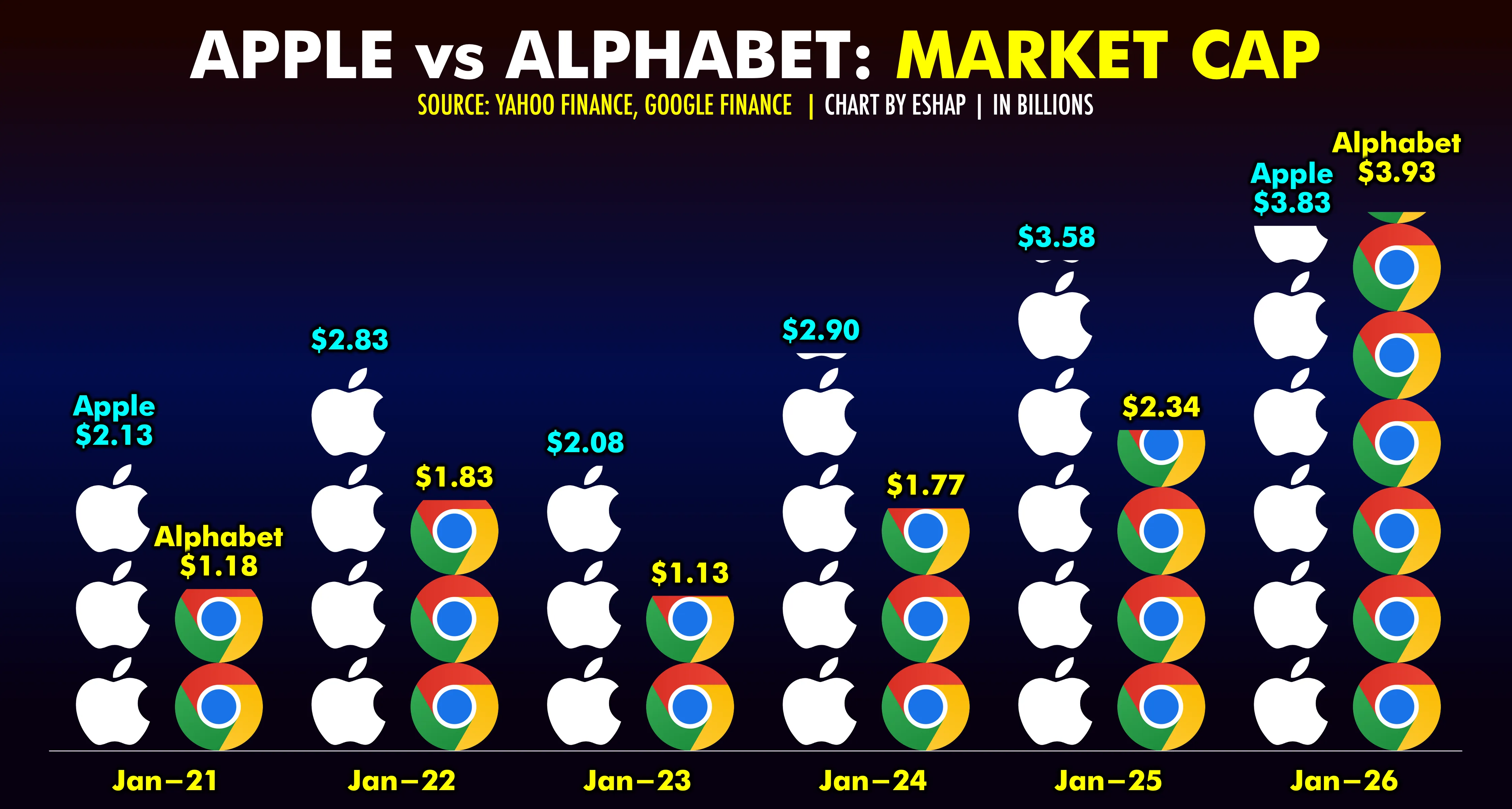
Alphabet has overtaken Apple in market capitalization — for the first time since 2019 — placing it firmly as the second-largest U.S. publicly traded company behind Nvidia.
Apple and Microsoft, once stalwarts at $4 trillion+, have seen their valuations pull back in recent quarters.
Nvidia, meanwhile, remains at the very top of the global market cap rankings, having even touched a $5 trillion+ valuation in recent months.
This shift is significant not just as a numeric milestone but as a strategic signal — it suggests that AI-driven growth prospects are eclipsing traditional hardware/software dominance in investor expectations.
What This Means for Investors & Markets
Market Psychology and Sector Influence
The surge in Alphabet’s valuation:
Highlights sector rotation toward AI and cloud growth stories within tech.
Reinforces the Magnificent Seven narrative — the group of dominant U.S. tech stocks that exert outsized influence on indices and investor sentiment.
Valuation Risk & Bubble Concerns
Despite strong gains, some market analysts warn:
Elevated tech valuations tied heavily to future expectations can be sensitive to slower-than-expected AI adoption.
Multiples for tech leaders, including Alphabet, remain high relative to historical averages.
Thus, while the milestone is impressive, it comes with increased expectations embedded in the share price.
Broader Economic and Industry Context
A few contextual trends help frame this development:
AI as a macro theme: Across tech markets, companies with credible AI strategies have significantly outperformed peers, often irrespective of current profitability.
Cloud computing growth: Google Cloud has shown robust enterprise traction, contributing meaningfully to revenue and valuation narratives.
Partnerships validate tech leadership: Deals such as Apple’s adoption of Gemini not only drive stock performance but signal wider ecosystem adoption of Alphabet’s technology.
Looking Ahead — What Could Change?
Potential Catalysts
New product launches and AI model upgrades
Further enterprise cloud adoption and strategic partnerships
Global expansion of AI services
Potential Risks
Regulatory pressures, especially in Europe and the U.S., could re-emerge.
Competition from other AI players like OpenAI, Microsoft’s Azure AI, and niche specialists.
Macroeconomic slowdowns that compress tech valuations broadly.
Conclusion
Alphabet’s official ascent to a $4 trillion market capitalization is much more than a round number — it is a culmination of:
Strategic repositioning around artificial intelligence, strong stock performance, regulatory relief, and signal shifts in investor expectations about where growth in tech really lives. As the company continues to monetize AI and enterprise cloud offerings while maintaining core advertising strength, its role in defining the next chapter of the markets — and tech megacaps — will remain central.